Tuesday, May 22, 2012

Kawagoe

On a nice, sunny Sunday we decided to head out of Tokyo for a change and visit the old city of Kawagoe. Located a little more than half an hour by train from Tokyo, it made for a perfect day-trip! The old town of Kawagoe has lots of cultural properties and historical sites fro the Edo period, and is therefore called "Little Edo". The experience of the ambience from a town of the Edo period makes Kawagoe a popular destinations among day-trip-tourists from Tokyo.

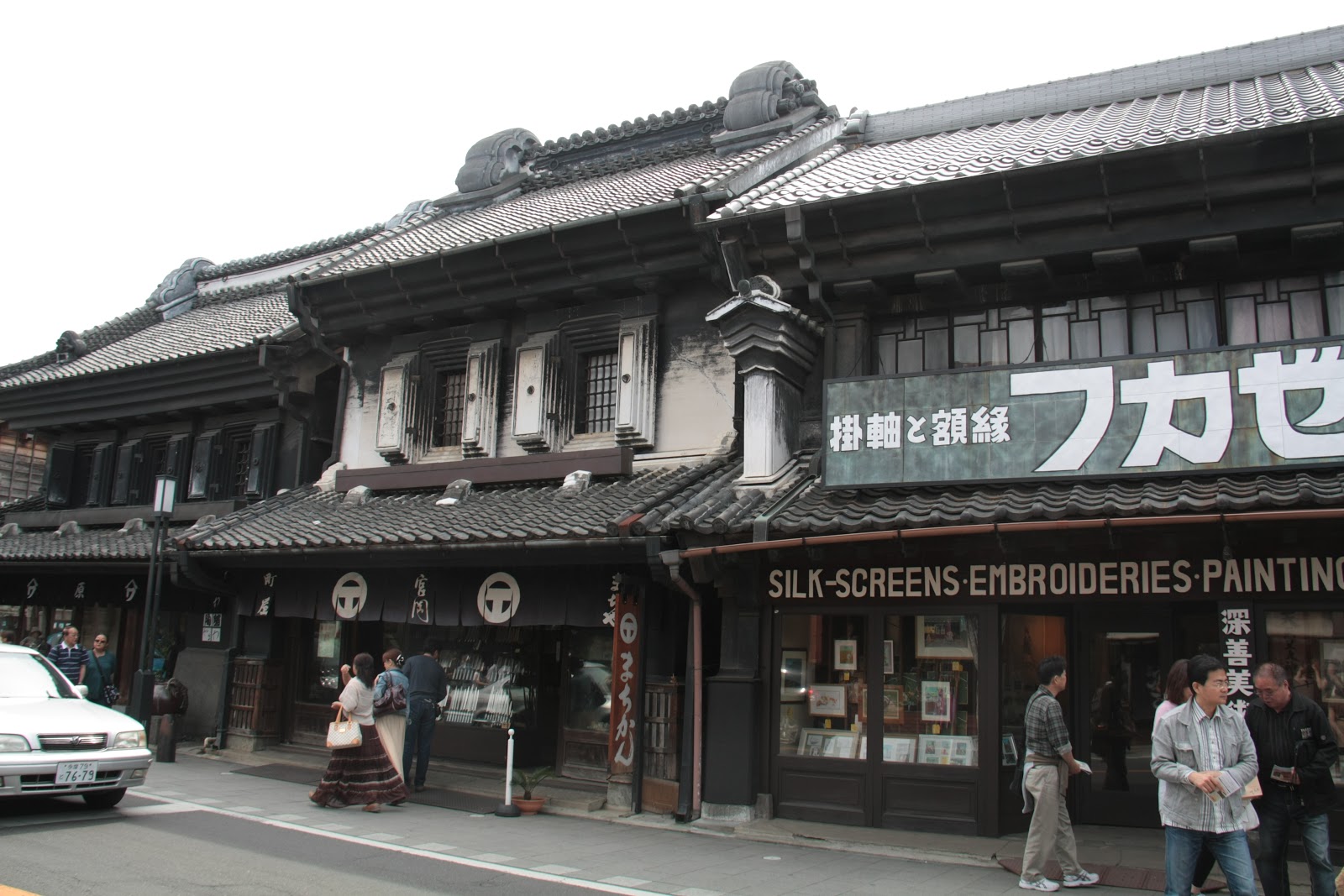
The main street of the old Town (Kurazukuri: clay-walled warehouses) is the perfect example of the Edo culture remaining in the city. It shows us a shopping street with old-style storehouses, still selling many interesting (traditional) items and food.

Main street with Edo-style storehouses
Shop selling chopsticks, and many different chopstick-rests
Edo-style shops
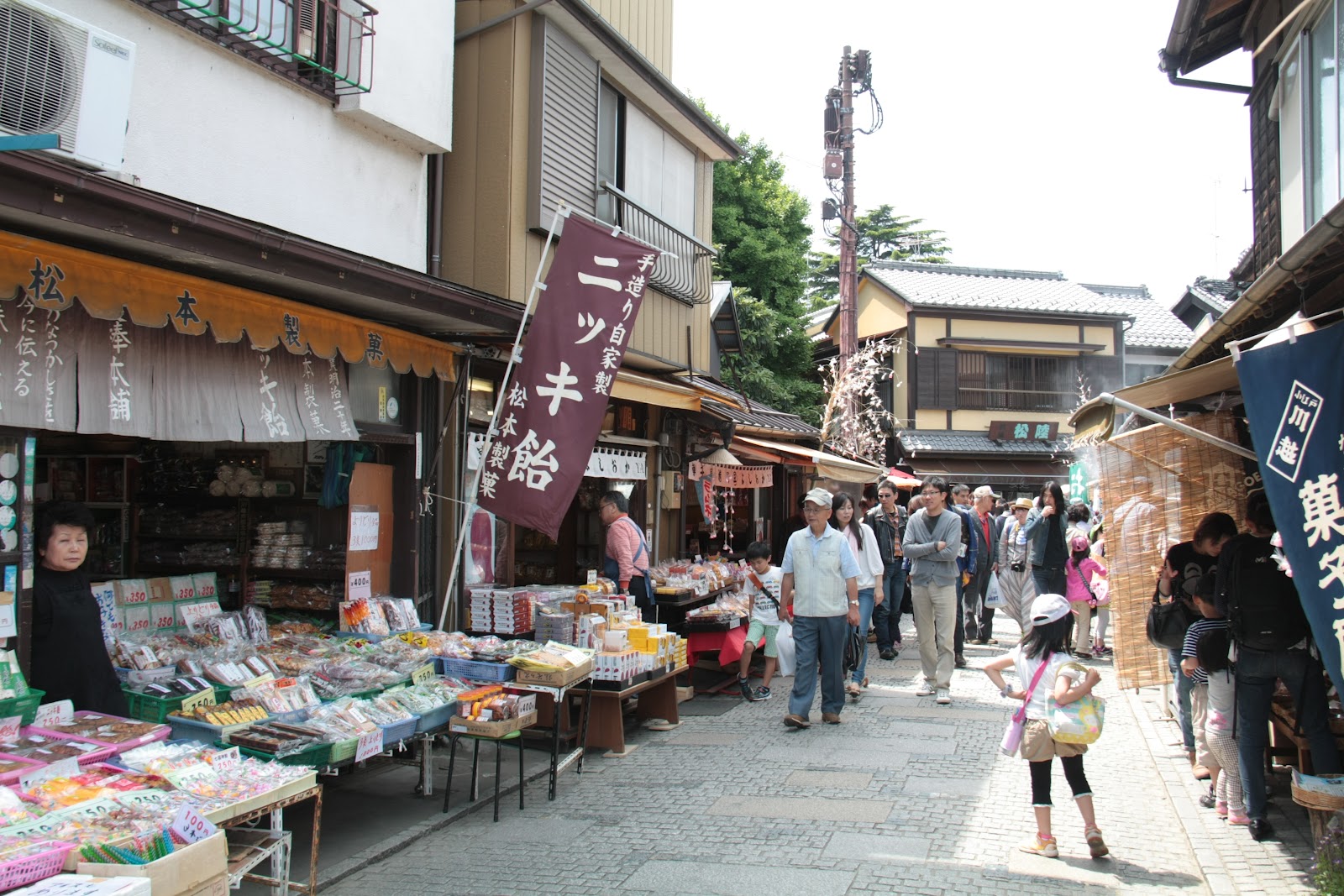
Kashiyayokocho (candy street) is a famous street enjoyed by many visitors, and also by us! This street consists of shops only selling traditional sweets and candies. We could try some various snacks as delicious cakes and rice cookies. Because Kawagoe is known for it's sweet potato, we off course had to try the local specialty: sweet potato ice cream! (with the tastes of purple and yellow sweet potato)

Candy street
Shop selling rice cakes
Purple and yellow sweet potato ice cream, 美味しい!

Kawagoe has many other interesting historical sites, as the famous Tokino Kane (bell tower), the Kawagoe Castle, and the Kitain Temple. On the grounds of the Kitain temple are the 538 Rakan statues, depicting the disciples of Buddha and all show a different posture and emotion.

In October a famous festival is held in the old town of Kawagoe, so we would like to go back to see the festivals and try some more traditional sweets.

Tokino Kane (Bell tower)
Kawagoe Castle
Rakan statues at the Kitain temple

Sunday, May 13, 2012

Tokyo Disney Sea

Last Friday was not a typical school day, as our school had an event scheduled for that day. The trimester agenda said we were to have an 'undokai', or sports event, with our classes. It turned out to be a whole other kind of event though....

Instead of sweating on some sports field, we went on a trip to Tokyo Disney Sea! Disney Sea is a one-of-a-kind Disney theme park focussing on a more mature audience. Inspired by the myths and legends of the sea, Tokyo Disney Sea is made up of seven themed areas: Mediterranean Harbor, Mystery Island, Mermaid Lagoon, Arabian Coast, Lost River Delta, Port Discovery and American Waterfront. 

Magic Mickey
The park is absolutely spectacular. It has amazing detailed landscaping (including a volcano), the attractions are very modern and high-tech which make them very fun and interesting to ride. Fortunately last Friday was a very quiet day by Disney standards, so we didn't have to stand in the infamous 3-hour long lines.

Our day started with each individual class exploring the park together. After three o'clock the trip was officially over but we were encouraged to stay as long as we wanted. So, back we went through the gates to start part II of the school trip.

One of the main attractions was the Tower of Terror in the American Waterfront area. A free-fall type attraction that is located inside a haunted elevator. The elevator brings you to the top of the tower where suddenly the windows open so you can get a brief view of the scenery before you crash down to earth. Scary!
Another popular attraction was the Indiana Jones Adventure, where you get a wild jeep drive through the Temple of the Chrystal Skull. Actually it reminded us a lot of sitting in a car with a certain former roommate of ours behind the wheel...
Mysterious Island features a submarine simulation ride which takes you to the depths of the dark ocean where the merfolk live. In Port Discovery there was a storm simulator that puts you in a helicopter designed to control the weather. Of course everything goes wrong and you escape death just by a few inches...

The park also had some spectacular parades and shows. Since the park was sea-themed all parades and shows were held in boats. In the afternoon we enjoyed a great show, and in the evening we could enjoy another show full of wonderful light-effects. The whole park was by then beautifully decorated in lights. The evening ended with fireworks above the Tokyo Disney Sea park, after which we went (very tired) back home after a great day.


Aladdin's Genie

Daphne in front of the Tempel of Doom


The volcano
The Haunted House...

Sunday, April 29, 2012

Aiki Jinja Festival

On the 26th of April the aikido community world wide commemorates the passing of the founder of aikido, Morihei Ueshiba. At the hombu dojo, this commemoration takes place in the form of screening movies of Ueshiba, followed by a gathering with drinks and speeches. So, after our regular aikido training last Thursday we watched the movies and enjoyed an interesting evening.
In the weekend following the 26th, in commemoration of his passing, the annual Aiki Jinja festival is held in Iwama, a small rural town north of Tokyo where he lived during World War II. It was here where aikido as it's practiced today came into being. While residing in Iwama, Ueshiba began constructing a shrine dedicated to the principles of aikido, the so-called Aiki Jinja. Every year since his passing the Ueshiba family gathers here and gives an aikido demonstration in honor of his life and accomplishments.

At the bronze statue of Morihei Ueshiba, O'sensei (great teacher)


This year we were able to attend the Aiki Jinja Festival and it was a very impressive event. Our day started at Ueno Station in Tokyo where we met with our aikido friends to get on the train towards Iwama. Slowly the urban environment of Tokyo was replaced by more spacious areas until our train was crossing the beautiful wide open countryside of Japan. After two hours we arrived at Iwama station, and followed the many, many aikido-practitioners visiting the festival.
The festival starts with a shinto-ceremony, followed by an aikido demonstration of Doshu and his son. Everyone then gathers together on the picnic field to enjoy a nice Japanese lunch and have some drinks. In the afternoon there is lots of time to look around, visit the Iwama dojo and take pictures of the shrine. It was our first time coming here, and it was a impressive experience seeing the Aiki Shrine and the Iwama dojo located between beautiful trees and greenery. The Iwama dojo is a big contrast to hombu dojo in Tokyo. It's crafted from wood and has many traditional elements. It breathes the authentic Japanese martial atmosphere, so to say. When we have the opportunity we definitely want to experience training there.

Gathering at the shrine
The dojo

After the ceremony the shrine was closed again


Saturday, April 14, 2012

Kasai Rinkai Park & Tokyo Sealife Aquarium

Even though our school has started again this week and we are spending our days studying, we want to give an update of our last spring holiday activity. In the last week of our vacation we visited the largest park in central Tokyo: the Kasai Rinkai Park and the Tokyo Sealife Aquarium.

The Kansai Rinkai Park is located at the outskirts of Tokyo and very close to Tokyo Disneyland. The park is a nice get-a-way from the busy city, and nice place to stroll around the various gardens, the beach and enjoy a nice view!


You can actually see the some attractions of Tokyo Disneyland from the park.

Located inside the park is the Tokyo Sealife Aquarium. A very nice aquarium showing many fish, sea-birds and penguins. The most impressive attraction is the big tuna tank. Here the viewing area is in the centre, and you stand in the middle of an incredible amount of tuna fish.


Below you can see the video I was making


More pictures at the photo album
Video's can be found here

Friday, April 6, 2012

Breakfast at Tsukji fish market


Because school is starting again next week and our days will be filled with studying, we decided to have a delicious Japanese breakfast before the spring vacation was over. So we woke up early and headed to Tsukiji fish market to find ourselves a nice restaurant for the perfect breakfast.

Tsukiji is a big fish market, where it is very busy with sellers and buyers of fish. You see lots of men driving around on 'standing cars', in order to transport the sold fish. You have to be careful when walking through the fish market to get to the various restaurants located at the side of the market. There are really lots of shops selling sushi and sashimi meals, it is a treat just to look around the different restaurants trying to decide on a place to eat! Some places are really popular and will have a big queue lined up in front of the store (or even continuing on the other side of the street!)

We chose a nice restaurant (with only a little queue) where they served our favourite fish meals: a salmon and tuna sashimi bowl served with sushi rice, pickles and miso-soup! It was really delicious, and the best raw fish meals we have ever tried. We would love to get here more often to try the different meal.

Queue to our restaurant
Salmon dish
Tuna bowl


Tuesday, April 3, 2012

Hot spring paradise: Kusatsu

As you may well know by now, we really like the Japanese hot springs, or 'onsen' as they are called here. Japan is a very volcanic active country and geothermic hot water is pleasant byproduct of this volcanic activity. Because the water flows naturally from the earth, onsen are full of minerals, salts and acids that are  good for your skin and health in general. One of the most famous hot spring towns in Japan is Kusatsu, a rustic mountain village that is known for its 'yubatake' (literally a cultivated field of hot water) and public onsen houses.

Woh ist der Bahnhof? Do ist der Bahnhof!


After a three hour trip by bus we arrived at our holiday destination. Even though spring already started  in Tokyo, there was still a massive layer of snow in the mountains. A big surprise! At the bus station we were greeted by a huge sign saying 'BAHNHOF'. There are German influences all over Kusatsu: houses, street names, street lanterns, souvenirs, you name it. Even the Japanese equivalent of Schnitzel (tonkatsu) is (coincidentally?) a local specialty. The reason for this fascination with Germany can be traced back to Dr. E. Bälz (1849-1913) who declared that the sulfur rich water in Kusatsu had certain benefits to the health. This declaration by an esteemed foreign scientist gave an enormous boost to Kusatsu's popularity as a spa-resort and spurred the local devotion to the Doctor's 'Heimat'.

We stayed at a little hotel on the edge of town. Like most hotels, ours had its own private onsen for guests. It was very modest in size but it felt like great luxury to have an onsen bath before breakfast and after dinner. An onsen that was certainly not modest in size was the Sai no Kawara in the (suprise!) Sai no Kawara park. This enormous onsen is about 500 square meters and is surrounded by beautiful mountains. A real treat! In the center of town is the yubatake, the main spring well. To distribute and cool the water so it can be enjoyed in the hotels and public bath houses, the water is poured in wooden tubes. All these tubes together resemble a farm field, hence the name 'yubatake': hot water field. Around the yubatake you can find small public bath houses. These are free and open 24/7. Because they're so close to the yubatake the bath water can be extremely hot! One way to cool the water is to use the traditional peddle: by splashing it in the water it cools down. Of course there's also a special way to do the splashing. Four times per day local ladies give a demonstration of this cooling ceremony (yumomi) accompanied by taiko drums, songs and dances. Another special onsen is the 'Ootaki no yu', this onsen features a special 'health course' where you have to take five consecutive baths with increasing temperatures (from 39 to 46 degrees!). Very very hot, but we finished it and now we should be healthier.  

    
End of the yubatake by night

Sulfur and yubatake tubes
Taking a foot bath

Daphne cooling the water
Water splashing


Our hotel
Public bath

Outside of public bath
Outside of another public bath
Special eleven
The last picture is from a one-of-a-kind Seven Eleven. To maintain the traditional brown color of the town center, Seven Eleven was originally not allowed to open a shop in Kusatsu. Only after the convenience store company was willing to change the trademark colors (yellow, green and red), the community allowed a store next to the yubatake.

More photo's in the photo album !